
Public Service Events: Where AUXCOMM Experience Begins
By Thomas Sarlitto, KD9JSA
When people think about emergency communications, they often picture hurricanes, tornadoes, wildfires, or large-scale disasters. While AUXCOMM personnel certainly play an important role during emergencies, many of the skills needed for those situations are developed long before disaster strikes.
One of the best training grounds for Auxiliary Communications volunteers is the public service event.
More Than Just Community Support
Every year, Amateur Radio operators and AUXCOMM volunteers provide communications support for hundreds of community events across the country, including:
Charity bike rides
Marathons and fun runs
Walk-a-thons
Parades
Community festivals
Triathlons
Search and rescue exercises
Public safety demonstrations
At first glance, these events may seem routine. However, they present many of the same communications challenges responders encounter during real emergencies.
Building Real-World Experience
Unlike classroom training, public service events place volunteers in dynamic environments where communication is critical.
Operators may be assigned to:
Aid stations
Medical tents
Rest stops
Traffic control points
Event headquarters
Mobile patrol units
Finish lines
Logistics checkpoints
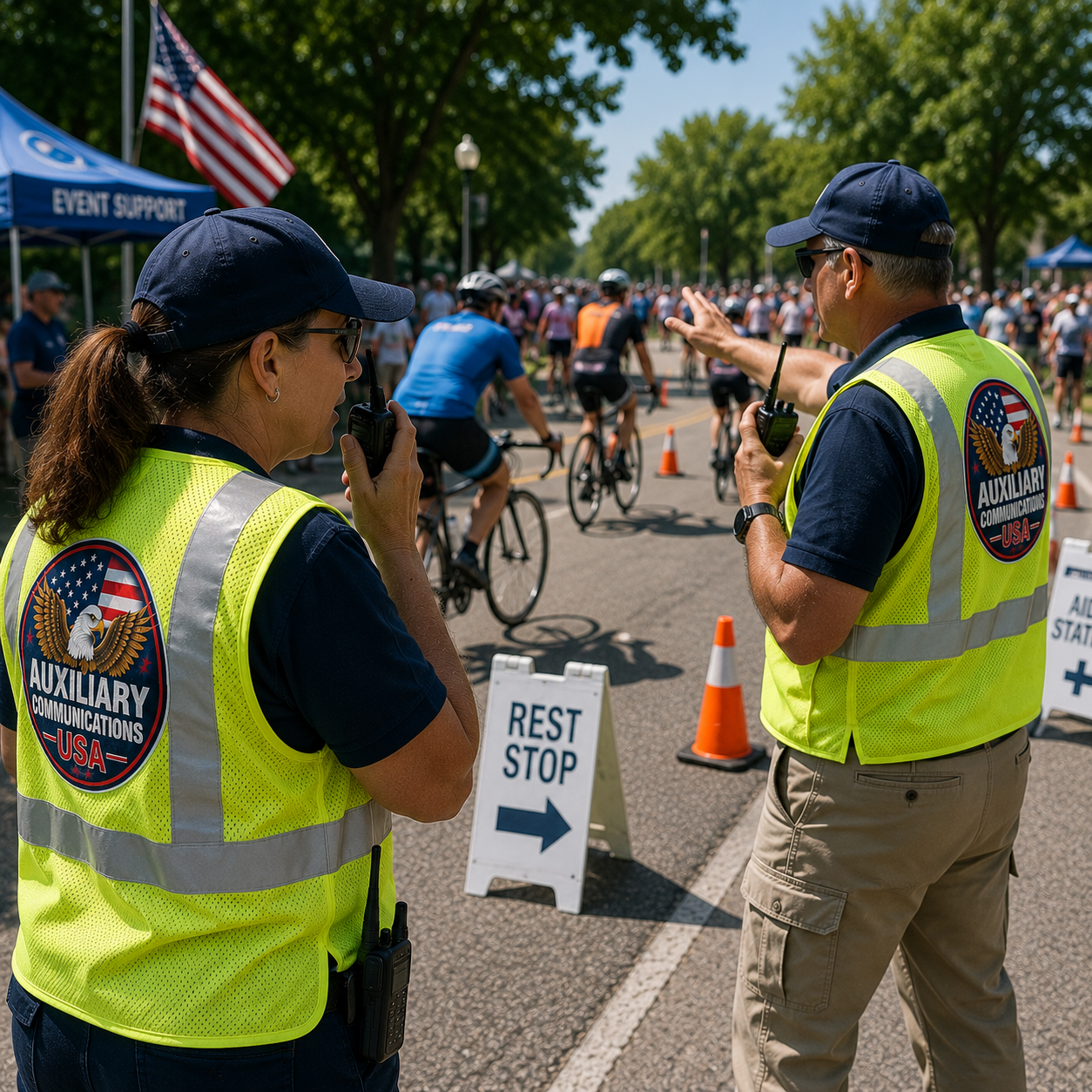
Throughout the event, volunteers relay important information such as participant locations, medical requests, changing weather conditions, road closures, supply needs, and safety concerns.
These activities help volunteers develop confidence while learning to communicate clearly, accurately, and professionally.
Learning the Incident Command System
Many organized public service events are managed using principles from the Incident Command System (ICS).
Volunteers learn how to:
Follow established communications procedures
Work within an organized chain of command
Document messages accurately
Coordinate with multiple agencies
Maintain communication discipline
Support event objectives rather than individual preferences
These experiences directly translate to emergency response operations.
Teamwork Makes the Difference
Public service events also teach one of the most important aspects of AUXCOMM: teamwork.
Successful communications depend on much more than radios.
Volunteers must coordinate with:
Event organizers
Emergency Medical Services (EMS)
Law enforcement
Fire departments
Public works
Emergency management
Logistics personnel
Fellow communications operators
Every successful event demonstrates that communication is ultimately about people working together toward a common objective.
Preparing for Larger Incidents
A bicycle ride or marathon may not seem comparable to a natural disaster, but the communication principles remain remarkably similar.
Volunteers learn how to:
Deploy portable equipment
Operate from remote locations
Pass accurate message traffic
Adapt to changing conditions
Solve unexpected problems
Maintain situational awareness
Coordinate with multiple stakeholders
These are the same skills required during severe weather activations, disaster response operations, and Emergency Operations Center (EOC) support.
Professionalism in Every Assignment
Whether supporting a local 5K race or assisting during a major emergency, AUXCOMM volunteers represent the emergency communications community.
Professionalism includes:
Arriving prepared
Wearing appropriate identification
Maintaining a positive attitude
Using clear and concise radio procedures
Remaining calm under pressure
Supporting the mission and the agencies being served
The goal is not simply to operate a radio—it is to become a trusted communications resource.
Every Event Is an Opportunity to Learn
No two public service events are exactly alike.
Each assignment provides opportunities to improve technical skills, strengthen teamwork, and gain valuable operational experience that cannot be replicated in a classroom.
For many AUXCOMM volunteers, today's community event becomes tomorrow's preparation for a real emergency deployment.
Final Thoughts
Public service events are often where AUXCOMM volunteers gain their first operational experience, develop confidence, and build lasting relationships with public safety partners.
They remind us that emergency communications is about far more than equipment or frequencies. It is about preparedness, professionalism, coordination, and service.
Every mile monitored during a charity bike ride, every checkpoint staffed during a marathon, and every parade supported by volunteer communicators strengthens the skills that communities may one day depend on during an emergency.
Because when the unexpected happens, experience matters—and many of those experiences begin with serving the community long before disaster strikes.
Images are AI Generated